How Outdoor LED Screens Withstand the British Weather: IP Ratings, Brightness and Durability Explained
25 Jun 2026Ask anyone who has lived through a British summer and they will tell you the same thing: you can experience four seasons in a single afternoon. A bright, glaring morning gives way to a downpour by lunchtime, a gusty, salt-laden breeze rolls in off the coast, and by evening the temperature has dropped enough to remind everyone that this is, after all, the United Kingdom. For most of us, this simply means keeping a brolly handy. But for any business investing in an outdoor LED screen, the unpredictability of the British climate is one of the most important factors in getting the specification right.
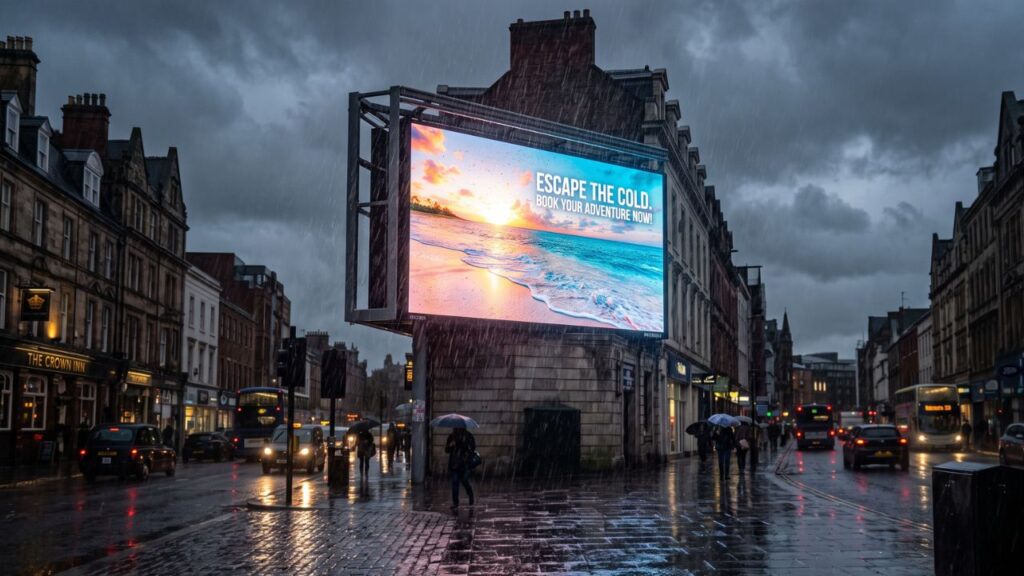
An outdoor display is a significant investment, and it is expected to perform reliably for years, often running for long hours every single day. To do that in the UK, a screen has to cope with persistent rain, condensation, fluctuating temperatures, strong sunlight, wind and, in coastal or urban locations, airborne grit and pollution. Choosing a display that has been engineered for these conditions is the difference between a screen that looks crisp and professional for a decade and one that fails, dims or develops faults within its first couple of winters.
In this guide, we explain the three things that matter most when specifying an outdoor LED screen for the British climate: weatherproofing, brightness and long-term durability. Understanding these will help you ask the right questions and avoid the costly mistake of installing an indoor-grade product in an outdoor setting.
Weatherproofing and IP Ratings: The First Line of Defence
The single most important specification for any outdoor display is its IP rating. IP stands for Ingress Protection, and it is an internationally recognised standard that tells you exactly how well a piece of equipment is sealed against solids and liquids. The rating is expressed as two digits, for example IP65. The first digit describes protection against solid objects such as dust, and the second describes protection against water.
The first digit runs from 0 to 6. A 6 is the highest possible rating and means the enclosure is completely dust-tight, with no ingress of particles whatsoever. This matters enormously in the UK, where airborne dust, pollen and pollution are a constant, and where coastal sites contend with fine salt particles that can corrode poorly protected electronics.
The second digit runs from 0 to 9. For outdoor use in Britain, you should be looking for a minimum of 5, which protects against water jets from any direction, while a 6 offers protection against powerful jets and heavy seas. A rating of IP65 is generally considered the practical benchmark for the front of an outdoor LED screen, ensuring that driving rain, the kind the UK delivers in abundance, cannot penetrate the display.
It is worth knowing that a quality outdoor screen will often carry different IP ratings for the front and rear of the cabinet. The front face, which is fully exposed to the elements, typically carries the higher rating, while the rear may be marginally lower because it is partially shielded by mounting structures. When comparing products, always check both figures rather than assuming a single headline number covers the entire unit.
Beyond the IP rating itself, well-designed outdoor displays also manage internal condensation. Temperature swings between a cold night and a sunny morning can cause moisture to form inside an enclosure, so reputable screens incorporate ventilation, sealing and sometimes internal climate control to keep components dry. This is one of the less visible aspects of quality engineering, but it is precisely the sort of detail that determines whether a screen survives a decade of British winters.
Brightness: Beating the Glare of Daylight
The second pillar of outdoor performance is brightness, and it is the area where indoor and outdoor displays differ most dramatically. Brightness is measured in nits, where one nit is equal to one candela per square metre. The higher the nit value, the brighter the screen, and the better it can compete with ambient light.
A typical indoor display might run at around 500 to 800 nits, which is perfectly adequate in a controlled environment. Place that same screen outdoors, however, and it will look washed out and almost invisible the moment the sun appears. For an outdoor screen to remain clear and legible in direct daylight, it needs to be considerably brighter, typically in the region of 5,000 to 7,500 nits, and sometimes higher for screens that face direct, unshaded sunlight.
This is a genuine consideration in the UK, despite our reputation for grey skies. On a bright day, even a hazy one, glare can render an underpowered screen useless precisely when footfall and visibility matter most. A shop front, a forecourt display or a roadside advertising screen has to cut through that glare to do its job.
The best outdoor displays do not simply blast out maximum brightness around the clock, which would be wasteful and, after dark, uncomfortably dazzling. Instead, they use automatic brightness adjustment, with ambient light sensors that continuously measure the surrounding conditions and adapt the output accordingly. The screen runs at full power under the midday sun, then dims gracefully at dusk and through the night. This protects against light pollution complaints, reduces energy consumption and prolongs the life of the LEDs, all while keeping content perfectly legible whatever the weather is doing.
Durability: Built to Last Through Every Season
The third pillar is durability, which ties everything together. Weatherproofing and brightness mean little if the underlying build quality cannot endure years of continuous outdoor operation. A genuine outdoor-grade screen is engineered from the ground up to handle the mechanical and thermal stresses that the British climate imposes.
Temperature tolerance is a key consideration. A quality outdoor display is designed to operate reliably across a wide range, from the frosts of a January morning to the heat trapped behind glass on the rare scorching afternoon. Thermal management systems, whether through clever ventilation or active cooling, prevent components from overheating in summer while ensuring the screen starts reliably in the cold.
Build materials matter too. Robust, corrosion-resistant cabinets, typically made from treated metals and sealed with weatherproof gaskets, resist rust and structural fatigue. For coastal installations, where salt air accelerates corrosion, specifying the right materials is especially important. Wind loading is another factor, particularly for larger screens or those mounted at height, and a professional installation will always account for the structural demands of the specific site.
Finally, durability is as much about installation and ongoing care as it is about the product itself. A screen that is correctly surveyed, securely mounted and properly commissioned will always outlast one that has been rushed into place. Routine maintenance, from checking seals to cleaning the surface and updating firmware, keeps a display performing at its best long after the day it was switched on.
Specifying With Confidence
Outdoor LED screens are a powerful way to capture attention, communicate dynamically and stand out in any setting, but only if they are built to survive the environment they are placed in. In the UK, that means demanding a high IP rating to repel rain and dust, sufficient brightness to beat the glare of daylight, and the build quality to withstand everything our changeable climate can throw at it.
The reassuring news is that screens engineered to these standards exist, and choosing the right specification from the outset removes any guesswork. If you are considering an outdoor display for a shop front, forecourt, roadside site or public space, the team at UNIFY VSN can help you specify a screen that will perform brilliantly through every British season. Get in touch to discuss your project and find the right solution for your location.